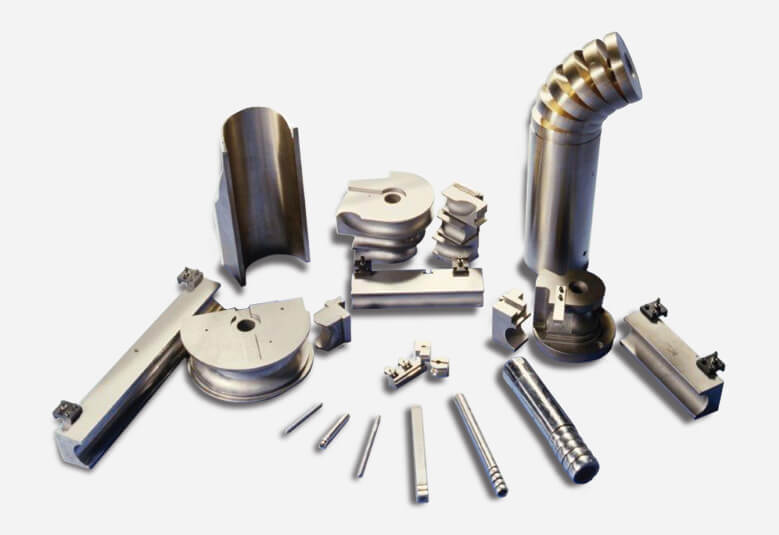
Automotive tube fabrication applications often require difficult manipulation of thin-walled materials, requiring a high degree of skill and precision.
From cranking fuel lines to interior components, automotive precision bending demands accuracy and repeatability to meet the high volume demands of automotive manufacturers. With complicated machinery, often exhaust components, required to continually evolve to fit into smaller and smaller spaces the demands of automotive bending are often a continuously moving target.
Our engineers excel at taking the complicated demands of the automotive industry and turning them into precise, repeatable processes ideal for high-volume repeatability. We often employ a process called boost bending to achieve the precise bends required, typically on small-radius tubing with shrinking material thickness.
Boost bending is a process where we push the material into the tools while the bend is being performed. This process helps ensure accurate bending without tube breakage. Vital to bending the types of tubing used in the automotive industry, boost bending plays a key part in the solutions we engineer for automotive applications.
Get In Touch With Us
Automotive Parts We Help Produce
- Exhaust systems, manifolds and converter inlets
- Fuel, brake and transmission-cooler lines
- Air-conditioning and coolant lines
- Seat frames, headrest rods and interior structures
- Chassis, roll-cage and structural tubing
Matching the Machine to the Part
- Tight-radius exhaust: booster benders such as the SOCO SR Series and PT Series control wall thinning on 1D bends
- Small-diameter lines: left/right benders such as the SOCO U Series and VLB EB-LR make complex 3D lines in one cycle, and the SOCO brake line benders are built for brake and fuel tubing
- Seat and frame parts: MRV hybrid benders combine draw and roll bending
- End forming: flares, beads and expansions for hose and coupling connections on end formers
Built for Volume
Automotive programs run at high volumes for years, so consistency matters as much as capability. Electric axes, automatic loading and unloading, and in-line cutting and end forming turn a bender into a production cell, so one operator can run more parts.
Frequently Asked Questions
What is boost bending and why is it used in automotive work?
Boost bending pushes material into the bend while it forms. That reduces wall thinning and breakage on the tight radii common in exhaust and fluid lines.
Can you automate a tube bending line for automotive volumes?
Yes. We build cells that combine benders with automatic loading, unloading, cutting and end forming.
Do you supply tooling for automotive parts?
Yes. Our tooling division supplies bend dies, mandrels, wipers and end forming tooling.