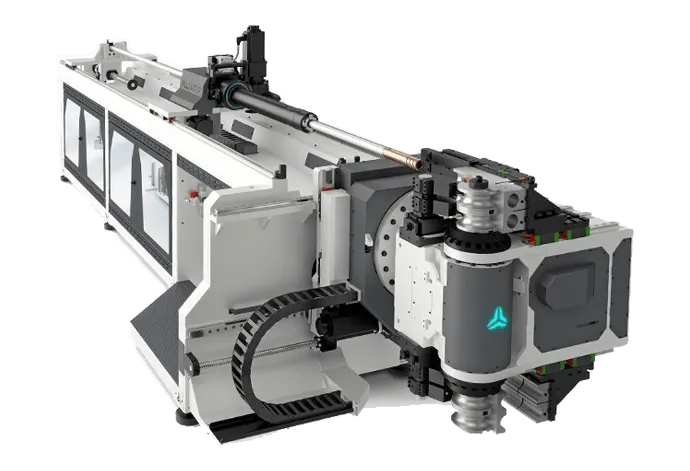
Comprehensive Guide to CNC Tube Bending Solutions: Types, Processes, Applications, and Precision Techniques
CNC tube bending is the automated process of forming metal tubing into precise, repeatable shapes using computer numerical control to manage tooling motion, pressure, and sequencing. This guide explains why CNC tube bending matters for manufacturers seeking dimensional accuracy, high throughput, and consistent surface finish across parts made from stainless steel, aluminum, titanium, and other alloys. Readers will learn the main machine classes, the mechanics of rotary draw and mandrel variants, industry use-cases from automotive to HVAC, and the precision techniques and tooling practices that ensure quality and repeatability. Common pain points—springback, wrinkling, ovality, and throughput constraints—are addressed with practical controls: tooling selection, mandrel strategies, CNC compensation, and process verification. The article is structured to cover the main machine types, a step-by-step rotary draw process explanation, mandrel bending principles and benefits, cross-industry applications with material and tolerance guidance, and a technical toolkit of precision techniques including tooling, programming, and QA methods.
What Are the Main Types of CNC Tube Benders?

CNC tube benders are specialized tube forming machinery that vary by drive system, bending method, and intended material range; the principal categories are fully electric, hydraulic, hybrid, rotary draw, compression, and roll benders. Each machine class controls force, axis motion, and tooling differently to balance precision, speed, and capacity for large-diameter or heavy-wall tubes. Understanding these differences is essential when selecting equipment for applications that demand tight bend radii, minimal surface deformation, or high-volume production. Below is a concise list defining each type and its primary value proposition.
Common CNC tube bender categories and a one-line summary of each:
- Fully electric CNC tube bender: high-precision, energy-efficient machines that excel at repeatability and low maintenance for thin-wall and precision parts.
- Hydraulic CNC tube bender: delivers high force for large-diameter or thick-walled tubes and heavy-gauge forming, suited to structural or industrial components.
- Hybrid CNC tube bender: combines electric controls with hydraulic power to offer a balance of precision and force for mixed-production environments.
- Rotary draw bender: the standard for tight-radius, profile-accurate bends using a bend die, clamp, and pressure die to control tube geometry.
- Compression bender: pushes the tube around a stationary die and is suitable for larger radii and simple bending tasks with minimal tooling complexity.
- Roll bender: uses rolls to gradually form large-radius curves in structural tubing and is ideal for architectural and large-frame applications.
This comparison helps engineers shortlist machine types before evaluating tooling and control options; the table below summarizes key attributes for each class.
Different CNC tube bender classes compared by key operational attributes:
Machine Type | Power Source | Typical Use-Cases | Advantage | Limitation |
Fully Electric | Electric servos | Precision, high-repeat jobs | Energy-efficient, low heat | Lower peak force for very thick-wall tubes |
Hydraulic | Hydraulic pumps | Heavy-wall, large OD tubing | High force, robust duty cycle | Higher maintenance, heat generation |
Hybrid | Electric + Hydraulic | Mixed production needs | Balance of force and precision | More complex integration |
Rotary Draw | Electric/Hydraulic | Tight radii, assemblies | Accurate profile control | Requires specialized tooling |
Compression | Electric/Hydraulic | Large radii, simple bends | Simple tooling, cost-effective | Less suited to tight radii |
Roll Bender | Electric/Hydraulic | Architectural curves | Large-radius capability | Not for complex multi-axis bends |
This table clarifies trade-offs across machine classes and supports early-stage selection. For manufacturers evaluating suppliers, Tube Form Solutions offers categorized machine lines and technical documentation that align with these machine classes and selection criteria, enabling engineers to compare electric, hydraulic, hybrid, and rotary draw platforms against production goals.
How Do Fully Electric CNC Tube Benders Enhance Efficiency?
Fully electric CNC tube benders use servo-driven axes to control rotation, clamp, and bending sequences, delivering precise motion control with rapid acceleration and deceleration profiles. The electric drive architecture enables regenerative energy recovery, reduced hydraulic heat, and lower overall energy consumption, which translates into improved uptime and reduced cooling requirements. Operation benefits include fine positioning for complex multi-axis bends, shorter setup times through digital tool libraries, and predictable maintenance schedules driven by wear metrics in servo systems. Typical applications include high-mix, medium-volume assemblies where consistency and low operating cost are priorities, such as medical frames, fluid lines, and precision furniture components.
Electric systems also simplify springback compensation through high-resolution feedback loops and allow easier integration of Industry 4.0 data collection for predictive maintenance. That capability makes electric benders attractive when part-to-part repeatability and tight tolerances matter; the next subsection examines hydraulic and hybrid designs where raw force and duty cycle requirements differ.
What Are the Features of Hydraulic and Hybrid CNC Tube Benders?
Hydraulic CNC tube benders employ pressurized fluid systems to provide the high bending forces necessary for large-diameter or thick-wall tubing, delivering sustained torque and duty cycles for heavy production. Hydraulics excel where material strength and wall thickness demand peak force to achieve required bend radii without excessive cycle times, but they introduce thermal management and periodic maintenance for seals and pumps. Hybrid systems pair electric controls and positioning with hydraulic power packs to get the best of both worlds: precise axis control plus high-force capability for challenging geometries.
Selection criteria for hydraulic versus hybrid systems should center on required bending force, expected production volume, and tolerance needs: choose hydraulic when peak force dominates, hybrid when precision control must accompany force. Maintenance checklists for these systems include fluid monitoring, seal inspection, and servo alignment; making the right choice prevents premature tooling wear and reduces scrap rates, which directly impacts per-part cost and throughput.
How Does the Rotary Draw Bending Process Work?
Rotary draw bending forms tubing by clamping the tube against a rotating bend die while a pressure die and clamp die control material flow; this coordinated action ensures the tube follows the die profile to achieve a precise bend radius and angle. The standard sequence is: secure the tube in the clamp die, advance a mandrel or internal support if needed, rotate the bend die to the programmed angle while the pressure die controls material feed, and release while compensating for springback in CNC software. This method produces consistent surface finish and dimensional accuracy, making it the preferred choice for tight-radius components and assemblies requiring high geometric fidelity. Typical defect modes—wrinkling, ovality, or excessive thinning—are managed with tooling choice, mandrel selection, wiper dies, and CNC compensation parameters.
Below is a step-by-step numbered process summary engineered to support featured-snippet style queries and shop-floor training.
Rotary draw bending steps:
- Clamp and Position: Secure the tube in the clamp die to set rotation origin and reference datum.
- Insert Internal Support: Deploy a mandrel or plug as required to support the internal wall and prevent wrinkling.
- Engage Pressure Die: Apply the pressure die to control material feed and prevent slipping during rotation.
- Rotate Bend Die: Drive the bend die to the target angle while monitoring force and axis position.
- Retract and Release: Withdraw mandrel and release clamp; apply CNC springback compensation if required.
This stepwise flow emphasizes the mechanical coordination and control tasks that underpin high-quality bends; the following paragraph explains the tooling and service support that complements rotary draw operations. Tube Form Solutions supplies tooling sets and service support tailored for rotary draw bending operations, including hardened die materials, mandrel options, and calibration services that help shops maintain consistent bend profiles and reduce downtime.
What Are the Key Components Involved in Rotary Draw Bending?
Rotary draw bending relies on a small set of precision tooling components: the bend die (which defines the bend radius), clamp die (which secures tube rotation), pressure die (which controls axial material flow), mandrel (internal support), and wiper die (which prevents wrinkling at the intrados). Each component is typically hardened and profiled to match tube OD and wall thickness, and material selection for tooling—high-grade tool steel or surface-treated alloys—affects wear life and surface finish. Tooling selection criteria include tube OD, wall thickness, target bend radius, and material grade; accurate measurement of push-off and backgauge positions is also critical for repeatable results.
Routine maintenance for these components involves inspection for wear, periodic regrinding or replacement of dies, lubrication of moving interfaces, and verification of mandrel articulation points. Proper component care minimizes variability and supports long runs without requalification, which is particularly important for assemblies with tight tolerances.
How Does Rotary Draw Bending Compare to Mandrel Bending?
Rotary draw bending is the overarching mechanical method; mandrel bending is a specific technique that uses an internal mandrel during rotary draw to better support the tube wall and reduce defects. The comparison centers on internal support: mandrel bending prevents wrinkling and ovality on thin-wall tubes or tight radii, while non-mandrel rotary draw is faster and sufficient for larger radii or thicker walls. In terms of finish and tolerances, mandrel-assisted bends typically achieve improved inner-surface smoothness and tighter dimensional control, at the cost of additional tooling complexity and slower cycle times.
Decision criteria for choosing mandrel versus non-mandrel rotary draw include material ductility, required inner-radius integrity, acceptable surface finish, and production volume. Shops often reserve mandrel setups for high-spec hydraulic lines, aerospace fluid systems, and medical tubing where internal geometry and smooth flow paths are essential.
What Are the Principles and Benefits of Mandrel Tube Bending?
Mandrel tube bending integrates an internal support element into the rotary draw process to prevent deformation and maintain cross-sectional integrity during tight-radius bends; this internal support may be a solid plug, a ball-type mandrel, or segmented mandrels depending on flexibility and support requirements. The mechanical principle is straightforward: the mandrel supports the inner wall, counteracting compressive stresses that cause wrinkling, while wiper dies address surface folding at the intrados. Mandrel bending yields improved dimensional control, better surface finish, and the ability to form tighter radii in thin-wall materials, making it essential for high-spec applications where internal flow or assembly interfaces are critical. Limitations include higher tooling cost, increased setup time, and potential for slower cycle times compared with non-mandrel operations.
Below is a focused benefits list that highlights practical advantages for engineering decision-making.
- Improved Surface Integrity: Mandrels reduce inner-surface wrinkling and maintain smooth flow paths.
- Tighter Bend Radii: Internal support enables tighter radii without collapse or excessive thinning.
- Dimensional Accuracy: Mandrel support reduces ovality and increases repeatable tolerance control.
These benefits explain why mandrel bending is specified for thin-wall stainless steel fuel lines, aerospace tubing, and medical device conduits; the next subsection clarifies how mandrels physically prevent deformation in technical detail.
How Does Mandrel Bending Prevent Tube Deformation?
Mandrel bending prevents deformation by providing internal compression support that counteracts the compressive forces at the tube intrados during bending, maintaining cross-sectional geometry and preventing wrinkling or collapse. Different mandrel types—solid plug mandrels for simple support, ball mandrels for flexibility through bends, and segmented mandrels for longer or complex profiles—are selected based on bend angle, radius, and material ductility. The mandrel's presence transfers compressive loads from the tube wall to the mandrel structure, enabling the outer fiber to stretch while the inner wall is supported and guided; wiper dies further minimize intrados folding by smoothing material flow near the die nose.
Further research and innovation continue to refine mandrel designs, particularly for the demanding requirements of ultra-thin-walled tubes in aerospace applications.
Advanced Mandrel Design for Precision Aerospace Tube Bending Due to their unique advantages of high strength, high performance, and light weight, ultra-thin-walled (UTW) tubes have attracted increasing application in the aviation and aerospace industries. However, wrinkling, cracking, cross-section distortion, and even collapse easily occur in UTW tube bending process. In this study, a new mandrel design method with variation in the mandrel ball thickness for bending UTW tubes was proposed to improve the forming quality. A new mandrel design with mandrel ball thickness variation for the bending process of aviation ultra-thin-walled tubes, H Li, 2022
Quantitatively, using a properly sized mandrel can reduce wrinkling incidence and ovality by significant percentages depending on material and geometry, and careful mandrel placement and sizing are a key part of process qualification. Proper mandrel selection and maintenance thus directly influence scrap rates and first-pass yield.
Which Industries Benefit Most from Mandrel Bending?
Mandrel bending is most valuable in industries where internal flow, surface integrity, and dimensional precision are non-negotiable—prominently aerospace, automotive fluid systems, medical devices, and high-end furniture or architectural components. Aerospace and automotive sectors demand tight tolerances and smooth internal passages for fuel and hydraulic lines, while medical device tubing requires wrinkle-free interiors and tight form factors. Materials commonly mandrel-bent include thin-wall stainless steels, copper-nickel alloys, and specialized high-strength alloys where maintaining circularity and surface quality is essential for function and certification.
Example components include fuel rails, hydraulic control lines, catheter shafts, and precision handrails; these parts often require tolerances in the low tenths of millimeters and documented process controls to meet industry specifications.
What Are the Key Applications of CNC Tube Bending Across Industries?
CNC tube bending finds application across multiple sectors, each with distinct component types, material preferences, and tolerance expectations. Automotive and aerospace demand high-volume, tight-tolerance bent assemblies like exhausts, chassis members, and fluid lines; construction and HVAC use larger-diameter structural tubing, handrails, and coil tubing for heat exchangers; medical and instrumentation sectors require small-diameter, thin-wall precision bends with exceptional surface quality. The following table maps industry to common components, material choices, and typical tolerance expectations to aid qualification and internal linking for case study development.
Industry map showing common CNC tube bending applications:
Industry | Common Components | Preferred Materials | Typical Tolerances |
Automotive | Exhaust pipes, chassis brackets, fuel/hydraulic lines | High-strength steel, aluminum | ±0.5–1.5 mm |
Aerospace | Fuel rails, actuators, hydraulic lines | Stainless steel, titanium | ±0.1–0.8 mm |
HVAC / Plumbing | Coils, manifolds, piping assemblies | Copper, stainless, carbon steel | ±1.0–2.0 mm |
Medical | Catheter shafts, instrument tubing | Stainless, Nitinol | ±0.1–0.5 mm |
Furniture / Architecture | Handrails, decorative frames | Stainless, aluminum | ±0.5–2.0 mm |
This table helps production planners estimate tooling and inspection needs while qualifying suppliers. The following H3s illustrate usage in key verticals and field installation considerations.
How Is CNC Tube Bending Used in Automotive and Aerospace Sectors?
In automotive manufacturing, CNC bending supports high-volume production of exhaust systems, chassis components, and fluid lines with consistent geometry and fast cycle times; electric and hybrid benders are often used for precision assemblies, while hydraulic or hybrid platforms handle larger-diameter, thicker-wall parts. Aerospace applications demand even tighter tolerances and surface integrity for fuel and hydraulic systems, frequently requiring mandrel-assisted rotary draw bending and rigorous process documentation. Material challenges include forming high-strength steels and titanium alloys that exhibit springback and work-hardening, necessitating robust CNC compensation strategies and frequent calibration.
Production planning in these sectors often pairs automated feeders, multi-axis bending cells, and inline inspection to meet throughput and quality requirements, and programmers use tool libraries and simulation to minimize first-article iterations.
What Are the Construction, HVAC, and Plumbing Applications of CNC Tube Bending?
Construction and HVAC sectors use CNC bending for handrails, structural frames, HVAC coil tubing, and prefabricated piping manifolds where consistent bends speed installation and reduce field labor. Material recommendations prioritize corrosion resistance and weldability: copper and stainless for HVAC/plumbing, carbon steel for structural applications with protective coatings. Prefabrication of bends to tight installation tolerances reduces onsite labor and improves system fit-up, especially in modular construction and MEP (mechanical, electrical, plumbing) prefabrication environments.
Installation considerations include tolerances for connection fit, threaded or flanged interfaces, and allowances for thermal expansion in HVAC systems; bent assemblies that arrive prequalified reduce rework and on-site adjustments.
Which Precision Tube Bending Techniques Ensure Quality and Repeatability?
Precision and repeatability in tube bending rely on a combination of tooling choices, CNC programming practices, process controls, and QA methods that together form a robust manufacturing system. Key techniques include mandrel support, active mandrel systems, multi-axis CNC control for compound bends, wiper dies for intrados protection, and careful bend sequencing to prevent collisions and cumulative springback errors. Repeatability is achieved by controlling variables: tool wear, clamp pressure, mandrel engagement depth, material batch properties, and environmental factors, then closing the loop with measurement systems such as CMMs and templates.
Below is a compact comparison table of precision techniques and their primary attributes to support tooling decisions and process planning.
Technique / Tooling | Supported Materials | Max/Min Bend Radius | Repeatability (±) | Typical Industries |
Solid Mandrel | Stainless, copper | Tight radii (≤2×OD) | ±0.2–0.5 mm | Aerospace, Medical |
Ball Mandrel | Stainless, thin-wall alloys | Tight to moderate radii | ±0.3–0.7 mm | Automotive, Fluid Lines |
Wiper Die | Thin-wall steels, copper | Moderate radii | ±0.5–1.0 mm | HVAC, Plumbing |
Active Mandrel | High-strength alloys | Very tight/complex radii | ±0.1–0.3 mm | Aerospace, Medical |
This comparison clarifies tool selection by material and tolerance requirements and supports calibration planning for repeatable production. The next H3s detail tooling optimization and CNC programming practices that make these techniques effective on the shop floor.
What Tooling and Accessories Optimize Precision in Tube Bending?
Tooling components—bend dies, clamp dies, mandrels, and wiper dies—determine how material flows during bending and directly affect surface finish, ovality, and dimensional accuracy. Accessories such as rotary unions, automated feeders, and centerline guides improve positioning and reduce human error, while measurement jigs and go/no-go fixtures enable rapid in-process verification. Tooling material choice and finish (hardened tool steel, PVD coatings) influence wear life and part finish; a planned maintenance schedule for inspection, regrinding, and replacement extends tooling longevity and preserves process capability. Cost-versus-lifespan trade-offs should be quantified when selecting tool materials and coatings to optimize total cost of ownership.
Documenting tooling life cycles and linking them to measurement outcomes helps production teams trigger preventive interventions before quality drifts occur.
How Does CNC Programming Enhance Precision and Efficiency?
Modern CNC programming provides springback compensation, offline simulation, tool and material libraries, and multi-axis coordination that collectively reduce trial-and-error during setup and improve first-pass yield. Simulations predict collision zones, required mandrel articulation, and potential thinning to enable pre-run adjustments; built-in material libraries store springback coefficients and recommended clamp pressures for common alloys. Integration with MES and data logging enables traceability and continuous improvement by correlating tool wear and process shifts with bend geometry deviations. Programming practices such as standardized tool templates, version-controlled parameter sets, and automated bend-sequencing logic shorten setup time and increase throughput.
When paired with precision tooling and consistent material batches, advanced CNC programming closes the loop between design intent and manufactured reality.
Tube Form Solutions supports these precision techniques with capability statements around precision tooling supply, programmable control integration, and after-sales calibration and training services that help manufacturers implement mandrel strategies, tool libraries, and measurement protocols without disrupting production ramp-up.
For inquiries about machine classes, tooling options, or process support, Tube Form Solutions welcomes project consultations to align equipment and tooling choices with application goals and quality requirements.