While not all bends require a mandrel, using a mandrel can offer a number of advantages. The purpose of a plug mandrel, for instance, is to prevent the tube from flattening as well as allowing the bend to be completed without wrinkles or kinks. Sometimes, however, even when using a mandrel tube wrinkling can occur.
What is Mandrel Tube Bending?
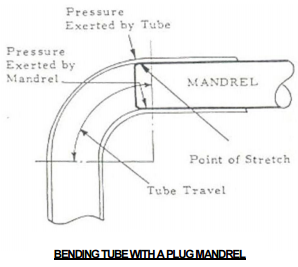
When using a mandrel tube bender, the mandrel is held in a fixed position while the tube is pulled over it. The tube stretching process is localized on the outer radius of the bend, and the material is work-hardened to retain its shape and not flatten. The material stretching is done on the forward tip of the mandrel. This force, acting on the mandrel tip, supports the inner radius of the bend, holding it firmly into the bend die groove.
To check whether a bend is likely to wrinkle, enter the OD, wall and radius in our free tube bending calculator. It shows the degree of bend, wall factor and a mandrel and wiper starting point.
Sometimes, however, problems can occur when bending. One of the most common problems we run across is tube wrinkling. There are a number of reasons that a tube may be wrinkling when using a mandrel tubing bender.
Top 8 Reasons for Tube Wrinkling
- Tube slipping in clamp die
- Mandrel is not far enough forward
- Wiper die not seated properly in bend die
- Wiper die worn or of improper fit
- Too much clearance between mandrel and tube
- Not enough pressure on the pressure die
- Improper or excessive amount of lubrication
- If mandrel and wiper die are in proper locations, check inboard pressure on the pressure die. You may need to apply more pressure on the pressure die to hold the tube into the die. Adjust in slowly until you have no wrinkles. Lastly, check mandrel fit.
How to Fix Tube Wrinkling, Step by Step
Work through the setup in this order and change one thing at a time:
- Check the clamp. If the tube slips in the clamp die, nothing else will hold. Look for witness marks and consider serrated or longer clamp inserts.
- Check the mandrel position. Move the mandrel forward in small steps until the wrinkles stop. Too far forward causes humps on the outside of the bend or a broken mandrel.
- Seat the wiper die. The wiper tip should sit as close to tangent as possible and touch the tube along its full length. Replace worn wipers.
- Check mandrel fit. Too much clearance between the mandrel and the tube ID lets the wall move. Match the mandrel to the actual ID.
- Adjust pressure die force. Increase slowly until the tube is held firmly in the bend die groove.
- Review lubrication. Use the right lubricant in the right amount. Too much on the clamp side can cause slipping.
Wrinkling vs. Other Common Bend Defects
| Defect | What you see | Common causes |
|---|---|---|
| Wrinkling | Ripples on the inside of the bend | Mandrel too far back, wiper missing or worn, low pressure die force, clamp slip |
| Flattening / ovality | Tube goes oval through the bend | No mandrel or too few balls, mandrel too far back, high wall factor |
| Wall thinning or cracking | Thin or split outside wall | Radius too tight for the material, mandrel too far forward, too much drag |
| Humps | Bulge on the outside of the bend | Mandrel too far forward |
| Springback | Angle opens after the bend | Material behavior; compensate by overbending in the program |
To check whether a bend is likely to need a mandrel and wiper die, use our tube bending calculator. For new tooling, request a tooling quote.
Frequently Asked Questions
Why does my tube wrinkle when using a mandrel?
The most common causes are the mandrel sitting too far back, a wiper die that is worn or not seated, too much clearance between the mandrel and the tube, low pressure die force, or the tube slipping in the clamp.
Does a wiper die stop wrinkling?
A wiper die supports the inside of the bend just behind the tangent point, where wrinkles start. On thin wall tube and tight radii it is usually needed along with a mandrel.
How far forward should the mandrel be?
The mandrel nose usually sits slightly past the tangent point. Move it forward in small steps until wrinkles stop. If humps appear on the outside of the bend, it is too far forward.
Can too much lubricant cause wrinkling?
Yes. Excess lubricant, especially on the clamp side, can let the tube slip in the clamp die, which leads to wrinkles and inconsistent bends.
Tube Bending Automation Cell
When using a traditional mandrel tube bending machine, troubleshooting can be a time-consuming process. Placement and positioning must be manually checked, and when complex or multiple bends are being performed on one machine, this can be a substantial task.
A tube bending automation cell can, among many other benefits, help to prevent some of the most common causes of tube wrinkling and also speed up the troubleshooting process.
A tube bending automation cell offers an easy setup and easy-to-use 3D software with a touchscreen. These make programing and using the tube bending automation cell for mandrel tube bending simpler and faster than manual bending. Because setup can be checked and potential problems explored within the software, often problems can be identified before a piece is bent.
Automation cells also offer robotic, automatic loading and unloading over a mandrel. This helps prevent some of the human errors that can lead to tube wrinkling.
You can see our tube bending automation cell in action below.
Learn More
Click here or follow the link below to download a free introduction to tube bending to learn more, troubleshoot bending problems, or contact us at any time with any questions or comments you may have.