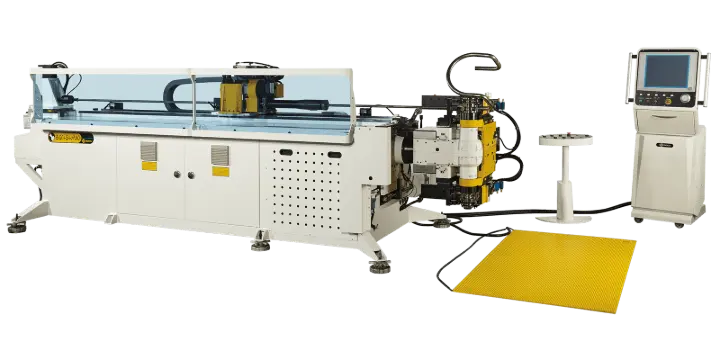
The difference between a perfect bend and a costly, scrapped part often has nothing to do with the bending machine itself — it comes down to the tooling. Bend dies, wiper posts, mandrels, and clamp dies all have to be specified correctly for your exact tube material, diameter, wall thickness, and centerline radius. Get any one of them wrong, and even a well-maintained CNC tube bender will produce inconsistent or defective parts.
Why Tooling Is the Real Precision Factor
A CNC tube bender controls the motion — the angle, the rotation, the feed rate. But it's the tooling that's in direct physical contact with the tube, and it's the tooling that determines whether the bend comes out clean or wrinkled, whether wall thickness stays within tolerance on the outer radius, and whether you get consistent, repeatable results bend after bend, shift after shift.
The Core Components of CNC Tube Bender Tooling
Bend Dies The bend die is the primary form the tube is pulled around. It has to match the tube's outer diameter and the specified centerline radius (CLR) precisely — an incorrect bend die is one of the most common causes of out-of-spec bends.
Clamp Dies The clamp die grips the tube against the bend die and provides the force that pulls the tube through the bend without letting it slip. Clamping pressure and die surface (smooth vs. serrated) need to match the tube material to avoid marking or slippage.
Pressure Dies Positioned opposite the bend die, the pressure die follows the tube through the bend, supporting it and, on boost-style benders, actively feeding tube material into the bend to reduce thinning on the outer radius.
Mandrels For tight-radius or thin-wall bends, a mandrel is inserted inside the tube to prevent the tube wall from collapsing or wrinkling on the inside of the bend. Mandrel selection (ball type, count, and sizing) has to match the specific CLR-to-diameter ratio of the bend being produced.
Wiper Dies (Wiper Posts) The wiper die sits at the point where the pressure die meets the bend die, smoothing out the tube surface to prevent wrinkling on the inside radius of tight bends — especially critical on thin-wall tube.
How to Specify Tube Bender Tooling Correctly
Getting tooling specification right up front avoids the trial-and-error cost of scrapped tube and machine downtime. At minimum, you need to define:
- Tube outer diameter and wall thickness
- Material (carbon steel, stainless, aluminum, copper — each behaves differently under bending force)
- Centerline radius (CLR) for each bend in the part
- Bend angle and part geometry, including any leg length or clearance constraints
- Bender make and model, since tooling mounting and sizing standards vary between manufacturers
If you're not sure where to start, our Guide to Specifying Tooling for a Tube Bender walks through this in more detail with a downloadable checklist.
High-Volume Tooling Management
For shops running high tube volumes, tooling isn't a one-time purchase decision — it's an ongoing inventory and wear-management problem. Bend dies and mandrels wear over time, and running worn tooling past its usable life is a common, often invisible cause of gradual quality drift.
Tube Form Solutions offers a vendor-managed inventory program for high-volume tooling customers, taking the logistics of tracking, reordering, and replacing tooling off your plate so production doesn't stall waiting on a die.
Turnkey Tooling from Tube Form Solutions
We supply high-quality, turnkey tooling solutions across the full range of CNC and hydraulic tube benders — from bend dies to wiper posts — along with premium metal forming lubricants engineered to reduce friction, tool wear, and surface marking during the bend.
Contact us to talk through your tooling specification, or download our Tooling Specification Checklist to get started on your own.
FAQ
What's the most common cause of tube bending defects? Incorrectly specified tooling — particularly bend dies that don't match the tube's outer diameter and centerline radius, or worn mandrels — is one of the most common root causes of wrinkling, thinning, and out-of-tolerance bends.
Do I need a mandrel for every bend? Not always. Mandrels are typically necessary for tight-radius bends and thin-wall tube, where the tube wall would otherwise collapse or wrinkle on the inside of the bend. Larger CLR-to-diameter ratios on thicker-wall tube may not require one.
Is tube bender tooling interchangeable between machine brands? No — tooling mounting and sizing standards vary between manufacturers, so tooling needs to be specified for your specific bender make and model.