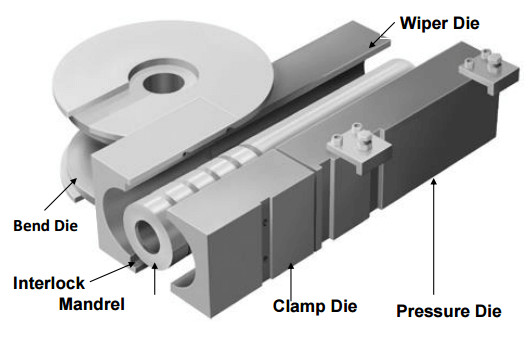
When first approaching bending tooling, it is necessary to understand a bit about bending in general as well as the various components that are used in the task. Each component contributes to the success of the operation, but the basic components include the bend die, clamp die, pressure die, wiper die, and mandrel.
Before we dive into each of these specific tooling components, however, let's look at some of the basics of tube and pipe bending in general.
What is Tube/Pipe Bending?
Tube and pipe bending, in its most simple state, is any process by which a piece of tube or pipe is reshaped. Tube and pipe bending is done so that the piece can be fitted to certain machines, as part of a larger whole like in an exhaust system, or in particular environments, like pipes that are used underground to carry material from one point to another.
Tube and pipe can be found in a wide range of applications and across nearly every industry. Some of the most common applications, however, are automotive applications (exhaust systems, headrests, etc.).
Each tooling component that we'll cover later is necessary to achieve the proper bend for whatever the end use application will be. Each component plays a vital role in how the piece of pipe or tube is bent.
How are Tube and Pipe Bent?
Tube and pipe can be bent manually, however, this is not very common. Two of the biggest reasons manual bending is an unpopular solution is that it is inconsistent and difficult to scale.
Far more common is tube and pipe bending which is done with a machine. Some bending machines rely on employees to use the machine, setting tooling and operating the machine manually, but more and more often companies are opting for CNC machining.
CNC, computer numerical control, and machining is more consistent than human-powered machines. CNC machines can also help assist in calculation performance. Additionally, CNC machines help eliminate confusion over which bending technique to use in a given circumstance.
There are many techniques for tube bending, and using the wrong one could do more harm than good. Even trained and experienced workers could make mistakes in the process they use or in physically performing the bend. So even owners and managers who have skilled employees will want to use CNC tube bending machines that help alleviate much of the risk and stress of tube and pipe bending.
As you can see from the diagram above, there are a number of pieces of tooling that are used during the bending process. Each of these components needs to be set precisely to achieve the correct bend. CNC machines can help ensure the right tooling is being used.
Additionally, the success or failure of any bend is often determined by calculations that are done even before the tooling is set. There are a number of calculations that need to be made when bending. Some of these calculations determine things like the ideal bend radius and others whether or not your specific equipment can even complete the bend.
Tube bending calculations and formulas can be tricky even for experienced tube and pipe benders, so we recommend checking out some of our resources on bending calculations if you need help or would like to learn more.
Perishable and Non-Perishable Components of Tube Bender Tool Sets
Tube bending components consist of both perishable components (those you will eventually have to replace) and non-perishable components (those you won't have to replace).
The two big pieces of perishable tooling are the wipers and the mandrel (Shank, body, nose, and ball mandrels all included). The non-perishable components include:
- Bend Dies
- Clamp Dies
- Pressure Dies
- Collet Pads
- Wiper Holders
- Wiper Posts
- Clamp Bolster
- Clamp Adjuster
- Bend Die Base (Boss)
- Bend Post (Tool Post)
The Bend, Clamp, and Pressure Dies
The first component to consider is the bend die. A bend die is used to form the tube and determines the radius of the bend. There are a number of standard die configurations, as well as pedestal and flange mount bend dies.
The application requirements will determine which style of bend die is appropriate, but pedestal and flange mount bend dies are used in situations where the height is larger than the width and for situations where there is not enough material left for a post through the hole.
The clamp die grips the tube against the bend die as the bend die rotates. While the pressure die applies, as its name implies, the pressure needed to bend the tube. The pressure die applies pressure by pressing the tube into the bend die.
The Wiper Die
The wiper die supports the tube on the inside of the bend to prevent wrinkles. Steel wiper dies are used for bending steel copper, aluminum, and bronze tubing. While aluminum/bronze wiper dies are used for stainless, titanium, and Inconel tubing.
Mandrels
The mandrel is the component that supports the inside of the tube, which prevents collapse and wrinkling during bending. Steel/chrome mandrels are used for bending steel, copper, aluminum, and bronze tubing. While Aluminum/bronze mandrels are used for bending stainless, titanium, and Inconel tubing. In addition to standard pitch mandrels, close pitch mandrels can be used for thin wall tubing and tight radius bends.
How to Specify a Bend Tooling Set
To quote or build a tooling set, your tooling supplier needs:
- Tube or pipe OD and wall thickness (for pipe, the true OD from the pipe schedule chart, not the nominal size)
- Material and temper, such as mild steel, 304 stainless or 6061-T6 aluminum
- Centerline radius (CLR) for each bend and the largest bend angle
- Shortest straight between bends, which sets the clamp length
- Bender make and model, centerline height and how the tooling mounts
- Quality requirements: ovality, wall thinning and surface finish
Our guide to specifying tube bender tooling covers each item, and you can send them straight to our tooling team through the tooling quote form.
When Do You Need a Mandrel and Wiper Die?
Two numbers decide most of it. Degree of bend is the CLR divided by the OD, and wall factor is the OD divided by the wall. Thick walls on generous radii often bend without a mandrel. As walls get thinner and radii tighter, you need a plug or ball mandrel, then more balls and a wiper die. Enter your OD, wall and CLR in our free tube bending calculator for a starting point, or see the formulas on our tube bending formulas page.
Tooling Materials
Bend, clamp and pressure dies are usually made from hardened tool steel for long life. Mandrels and wiper dies wear fastest because they rub on the tube on every bend, so they are made from hardened steel, chrome-plated steel or aluminum bronze. Aluminum bronze is common on stainless steel because it resists galling. Good lubrication extends the life of every component.
Frequently Asked Questions
What are the 5 basic tube bending tooling components?
The bend die, which sets the centerline radius; the clamp die, which grips the tube to the bend die; the pressure die, which supports the outside of the bend; the wiper die, which prevents wrinkles on the inside of the bend; and the mandrel, which supports the inside of the tube.
Which tube bending tooling wears out fastest?
The wiper die and mandrel are perishable tooling. They contact the tube on every bend and wear faster than the bend, clamp and pressure dies.
Can I use tooling from one tube bender on another?
Sometimes. Tooling must match the bender’s centerline height and mounting, so tooling from a different make or model often needs modification or replacement. Send your bender make and model with your tube size to check.
How do I know what tooling I need?
Start with your tube OD, wall, material and centerline radius. These set the bend die, the degree of bend and the wall factor, which decide whether you need a mandrel and wiper die. Our tooling team can confirm the full set from your part print.
Want to Learn More?
Introduction to Rotary Draw Bending Tooling, explains these basic components as well as many other bending tooling basics. In this free guide, you will find:
- Introduction To Rotary Draw Bending
- Engineering Guidelines
- Tight Radius Bending
- Completing the Application Review
- Special Considerations & Applications
- Summary and Benefits
Click here or click the button below to download the Introduction to Rotary Bending Tooling.
Ready to price a set? Send your tube size, radius and bender model through our tube bending tooling quote form.